SYNCGEN Hybrid Control System · Pakistan
PV Genset & PV-DG Controller in Pakistan
Solar diesel controller and PV–genset integration in Pakistan for stable generator loading, reverse-power prevention, grid export limits, intelligent PV curtailment and unified SCADA visibility.
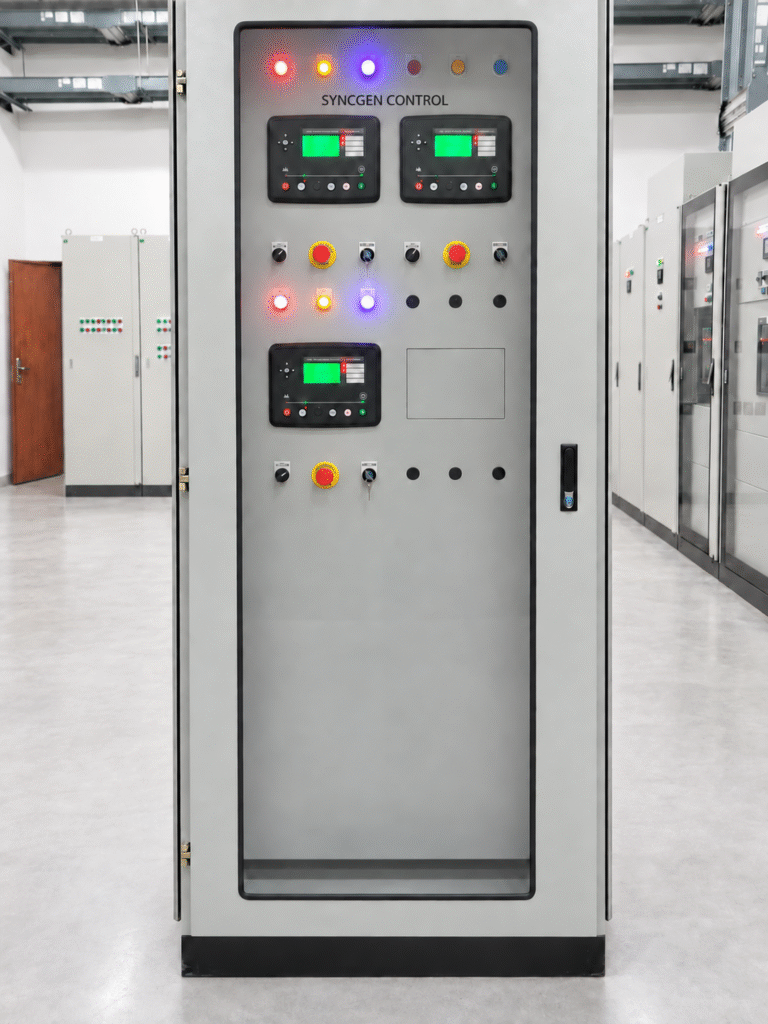
Industrial installation evidence
PV-Genset Control Proven in Pakistan
JME Energy & Automation integrates solar PV, diesel generators, utility supply and plant SCADA around actual operating requirements. Explore two documented multi-source projects rather than generic controller claims.
Industrial automotive manufacturing · Lahore
Sazgar Engineering Works
Approximately 5 MW solar · 3 synchronized generators · Unified SCADA & EMS
Plant-wide integration covers solar, generator coordination, utility monitoring, load management and weather data. The documented project includes PV-genset control designed around site-loading requirements.
Explore the Sazgar project →Hybrid energy integration · Quetta
UNICEF Quetta Facility
100 kW SOFAR on-grid solar · 2 generators · GoodWe hybrid system
SYNCGEN EMS integrates utility, generators, on-grid and hybrid inverters, battery storage and weather monitoring. Solar control limits adapt to utility and generator operating modes.
Explore the Quetta project →Solar diesel hybrid control
Solar diesel controller integration in Pakistan
A solar diesel controller regulates PV output while diesel generators supply the site. JME engineers this function within SYNCGEN around the installed inverter models, generator controllers, metering and operating modes. Single-generator and multi-generator plants need different control limits as online capacity changes.
The scope can include minimum genset-loading reserve, compatible inverter power commands, alarms and trends, with generator protection coordinated separately. Fuel savings depend on the load profile, usable solar and generator operating limits; the controller alone does not establish a guaranteed saving.
For an installed hybrid example, see UNICEF Quetta and other JME integration projects. For grid-connected operation, review solar export-limit and zero-export control. Send the SLD, inverter models and genset/controller details for a solar diesel control assessment.
Direct answer
What is a PV–genset controller?
A PV–genset controller coordinates solar inverter output while one or more diesel generators are operating. Using live power measurements and generator status, it regulates permitted PV generation to respect the plant’s approved generator-loading limits and reduce reverse-power risk. JME engineers this control through SYNCGEN around the installed inverters, generator controllers, metering and operating modes.
Common site problems
Your solar is installed. But does it work properly when the generator starts?
Many industrial PV systems perform normally on WAPDA but become unstable when generators take over. The issue may be control architecture, metering, inverter curtailment, generator loading or coordination between equipment—not necessarily a failed inverter or genset. Why solar and generators can conflict →
Review the changeover sequence, inverter operating conditions and PV–genset control philosophy.
Measure real power direction and dynamically limit PV before sustained backfeed reaches the genset.
Coordinate solar output with an engineered minimum genset-loading reserve.
Account for changing online capacity, synchronization, load sharing and common-bus operation.
Assess existing meters, controllers, inverter communications and switchgear before replacing equipment.
Design today’s PV–DG control so the architecture can expand toward BESS and plant-wide EMS/SCADA.
Related engineering systems
PV–DG control often forms part of a wider plant architecture. Explore genset synchronization and load sharing, zero export controller and solar export-limit engineering, PV-DG reverse-power protection and minimum genset loading, multi-genset PV-DG and common-bus control, industrial EMS and energy monitoring, and BESS integration with solar, grid and generators. For outage and islanding design, see JME’s grid-forming vs grid-following BESS engineering guide.
Control functions
One control layer across solar, generators and loads
Modulates available PV output to maintain the configured generator loading reserve.
Monitors real power direction and acts before sustained backfeed reaches the generator or grid.
Limits solar export at the selected point of common coupling where the plant requires it.
Sends compatible active-power limits to networked solar inverters through available interfaces.
Accounts for changing generator availability, common-bus operation and total online capacity.
Supports staged load priorities, alarms and control outputs when the approved design requires them.
Uses distinct operating limits for utility-connected and generator-supported plant conditions.
Unifies live measurements, operating state, alarms, trends and event information.
Can correlate irradiance and environmental measurements with PV performance and plant operation.
SYNCGEN architecture
Customized around installed equipment
JME’s SYNCGEN solution is configured around the plant’s real meters, genset controllers, inverter communications, switchgear, loads and operating priorities. It is not treated as a universal plug-and-play box.
- Modbus RTU, Modbus TCP and documented equipment interfaces
- Deep Sea, DEIF, Woodward, ComAp and Sices integration where register access is available
- Single or multiple generators and common-bus arrangements
- On-grid solar inverter active-power control where supported
- Local HMI, centralized SCADA and remote monitoring options
- Alarm, trend, event and operating-mode visibility
- Engineering review, FAT/SAT, commissioning and handover
Terminology explained
Solar diesel, PV–genset and zero-export controllers: scope explained
PV Diesel / PV Genset Controller
Coordinates solar production with one or more operating diesel generators and their minimum-loading constraints.
Zero-Export Controller
Controls export at the grid connection point. It may not provide generator-aware logic unless specifically engineered.
Hybrid / Microgrid Controller
A broader control layer that may coordinate grid, gensets, PV, BESS, loads, switchgear and islanded operation.
Fuel reduction depends on solar availability, load profile, generator efficiency, minimum-loading limits, inverter controllability and the approved operating strategy. JME does not publish universal savings claims without site data.
Real project evidence
Check solar headroom against minimum genset loading, then review JME field evidence and control architecture.
From PV–genset control to unified industrial EMS
At Sazgar Engineering Works — the Pakistan car manufacturing operation associated with GWM HAVAL vehicles — JME’s phased integration expanded into unified SCADA and energy management covering solar, WAPDA, synchronized gensets, plant loads, automatic load shedding, VCB operations and weather-station data.
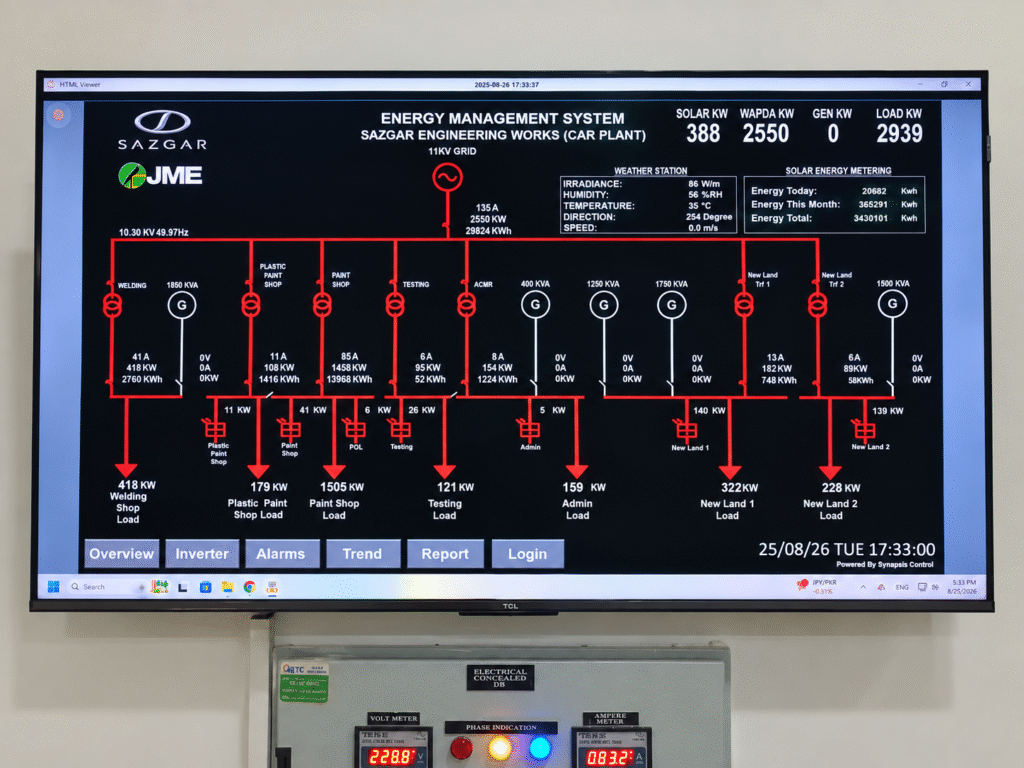
PV–genset engineering in Pakistan
Compatibility is verified against the exact inverter model, firmware, gateway/register map and writable active-power interface before commitment.
Check PV–DG inverter compatibility →
Who provides PV–genset controller integration in Pakistan?
JME Energy & Automation engineers and integrates PV–genset, PV–diesel and solar-hybrid control systems for industrial sites in Pakistan. The solution is designed around the installed generator controllers, solar inverters, metering architecture, communication interfaces and operating objectives—not around a one-size-fits-all controller. JME also engineers genset synchronization and load sharing, industrial EMS and centralized SCADA, so PV–DG control can remain part of the plant-wide operating architecture rather than an isolated controller.
New-system integration
Control architecture for solar PV, one or multiple gensets, WAPDA/grid, common busbars, protection and centralized SCADA.
Retrofit and recovery
Independent review of unstable PV–diesel control, missing logging, incorrect metering, reverse-power risk and unsupported legacy systems.
Engineering evidence
SLD development, controller and inverter interface review, commissioning logic, trends, alarms and project-specific operating safeguards.
Commercial planning
PV Genset Controller Price in Pakistan — What Determines the Cost?
There is no single responsible fixed price for an industrial PV–genset or PV-DG controller in Pakistan. A simple one-genset site and a multi-genset common-bus plant require very different metering, communications, control logic, panel work and commissioning. A useful quotation should therefore be based on the actual SLD and installed equipment—not only the solar kW rating. If you’re comparing full solar proposals, use the solar installation quote checklist to check whether each bid includes generator integration, metering and commissioning.
Single-genset control is different from coordinating two or more generators with changing online capacity, synchronization and load sharing.
Cost changes with the number of utility, generator, solar and load measurement points required for dependable control and verification.
Huawei, Sungrow, Solis, SOFAR, GoodWe, Growatt and other platforms may require different gateways, protocols, firmware checks and active-power command methods.
Minimum genset loading, reverse-power prevention, zero export, PV curtailment, multi-genset logic and load management each add different engineering requirements.
A local controller-only scope is different from a system with operator HMI, alarms, trends, historian, reporting or remote supervision.
Panel modification, breaker feedback, cable distances, communication wiring, FAT/SAT and site commissioning materially affect the final project scope.
Engineering answers
PV–genset controller FAQs
Is a PV genset controller the same as a reverse-power relay?
No. A reverse-power relay is a protection device. A PV–genset controller actively regulates solar output using live power measurements and compatible inverter commands. Protection devices remain part of the engineered electrical protection scheme.
Can one controller work with different inverter brands?
Integration depends on whether the inverter exposes a supported communication protocol, active-power control command and usable register map. JME reviews the exact inverter model and firmware before confirming compatibility.
Can it control multiple generators?
Yes, subject to the system architecture. The design must account for generator status, online capacity, common-bus conditions, minimum-load reserve, load-sharing arrangement and failure modes.
Does a PV diesel controller guarantee fuel savings?
No fixed percentage can be guaranteed without site measurements. The controller enables safer use of available solar while gensets operate; actual savings depend on the plant load, solar resource, genset efficiency and operating constraints.
Can JME integrate an existing solar and genset installation?
Yes. JME first reviews meters, controllers, inverter interfaces, SLDs, switchgear and operating requirements, then defines whether the existing system can be integrated, requires retrofit or needs selected replacement.
Can weather-station data be included?
Yes. Irradiance, wind, temperature, humidity and other available sensors can be integrated into SCADA or EMS for performance context, subject to the chosen station and communication interface.
Planning PV operation with generators?
Send the inverter models, generator controllers, SLD and operating objective for an engineering review.