BESS EPC & Integration Partner
From feasibility and system sizing to electrical integration, EMS/SCADA, commissioning and handover—JME helps industrial facilities build a battery energy storage system that works with solar, generators and the utility grid.
Where can JME help?
JME Energy & Automation can support a project as a full-scope BESS EPC partner under an approved scope, or as the specialist integration partner connecting equipment from selected vendors into one dependable operating system.
Our engineering focus is not limited to supplying a battery cabinet. We define how the battery storage system should interact with plant loads, PV inverters, diesel generators, WAPDA/grid supply, protection relays, meters, PLCs and the central EMS or SCADA.
Turnkey BESS delivery
Site assessment, concept design, vendor coordination, installation interfaces, controls, commissioning and documented handover.
Multi-vendor system integration
Bring BMS, PCS, solar, genset and grid data into one coordinated control architecture.
Independent engineering
Review sizing, topology, SLD, protection philosophy, operating modes and technical offers before purchase.
Testing & troubleshooting
Communication testing, sequence validation, alarms, interlocks, FAT/SAT support and control-system rectification.
How to select the right BESS
A suitable BESS begins with the operating problem. JME converts the load profile and required operating modes into an engineering basis for vendor-neutral selection.
Define the duty
Peak shaving, backup, solar shifting, generator support, load shedding, zero export or power-quality support.
Size power & energy
Separate required power in kW/MW from usable energy in kWh/MWh, then verify duration, C-rate and reserve SOC.
Check the interfaces
Confirm voltage level, transformer, switchgear, PCS, protection, communications and existing PV/genset controls.
Validate lifecycle
Evaluate ambient conditions, degradation, usable depth of discharge, warranty terms, safety and local support.
AC-coupled vs DC-coupled BESS
Neither topology is universally “best.” The correct choice depends on whether the site is new or existing, how solar is connected, the required operating modes and the degree of independent control.
| Decision factor | AC-coupled BESS | DC-coupled BESS |
|---|---|---|
| Typical fit | Existing facilities, retrofit PV and multi-source plants. | New solar-plus-storage projects designed as one DC architecture. |
| Control independence | Battery PCS and PV inverter can be dispatched independently through EMS. | Battery and PV share a DC-side conversion path; coordination depends on the selected architecture. |
| Solar clipping | May not directly capture clipped DC energy without additional design provisions. | Can capture otherwise clipped solar energy when correctly sized and controlled. |
| Flexibility | Usually easier to retrofit, isolate and expand across plant buses. | Can be efficient for tightly integrated new systems but may reduce vendor and retrofit flexibility. |
| Engineering watchpoints | Multiple conversion stages, transformer/switchgear interfaces and coordinated protection. | DC voltage window, shared inverter limits, DC protection and single-path dependencies. |
VSG, seamless transfer and synchronisation
Grid-following / non-VSG
Common PCS operation follows an established voltage and frequency reference. It suits many grid-connected applications but may not independently form a stable islanded bus.
VSG / grid-forming
A virtual synchronous generator strategy can establish or support voltage and frequency, provide synthetic inertia and improve islanded operation—subject to the PCS capability and the complete protection/control design.
What “seamless” really requires
Fast transfer is a system function, not a single equipment feature. It requires source-status detection, an approved transition sequence, stable voltage/frequency control, sufficient BESS headroom, correctly coordinated breakers and validated interlocks.
Role of a sync-check relay
A sync-check relay supervises voltage magnitude, frequency and phase-angle conditions before permitting two live sources or buses to close together. The control system commands the sequence; the relay provides an independent permissive layer.
BMS vs PCS vs EMS vs PMS
Battery Management System
Monitors cells, modules, temperature, SOC/SOH, limits and battery safety states.
Power Conversion System
Converts AC/DC power and executes active/reactive power commands within limits.
Energy Management System
Optimises dispatch using tariffs, load, solar, generator status, SOC and operating priorities.
Plant control & visibility
Coordinates sources, breakers, interlocks, load shedding, alarms, trends and operator control.
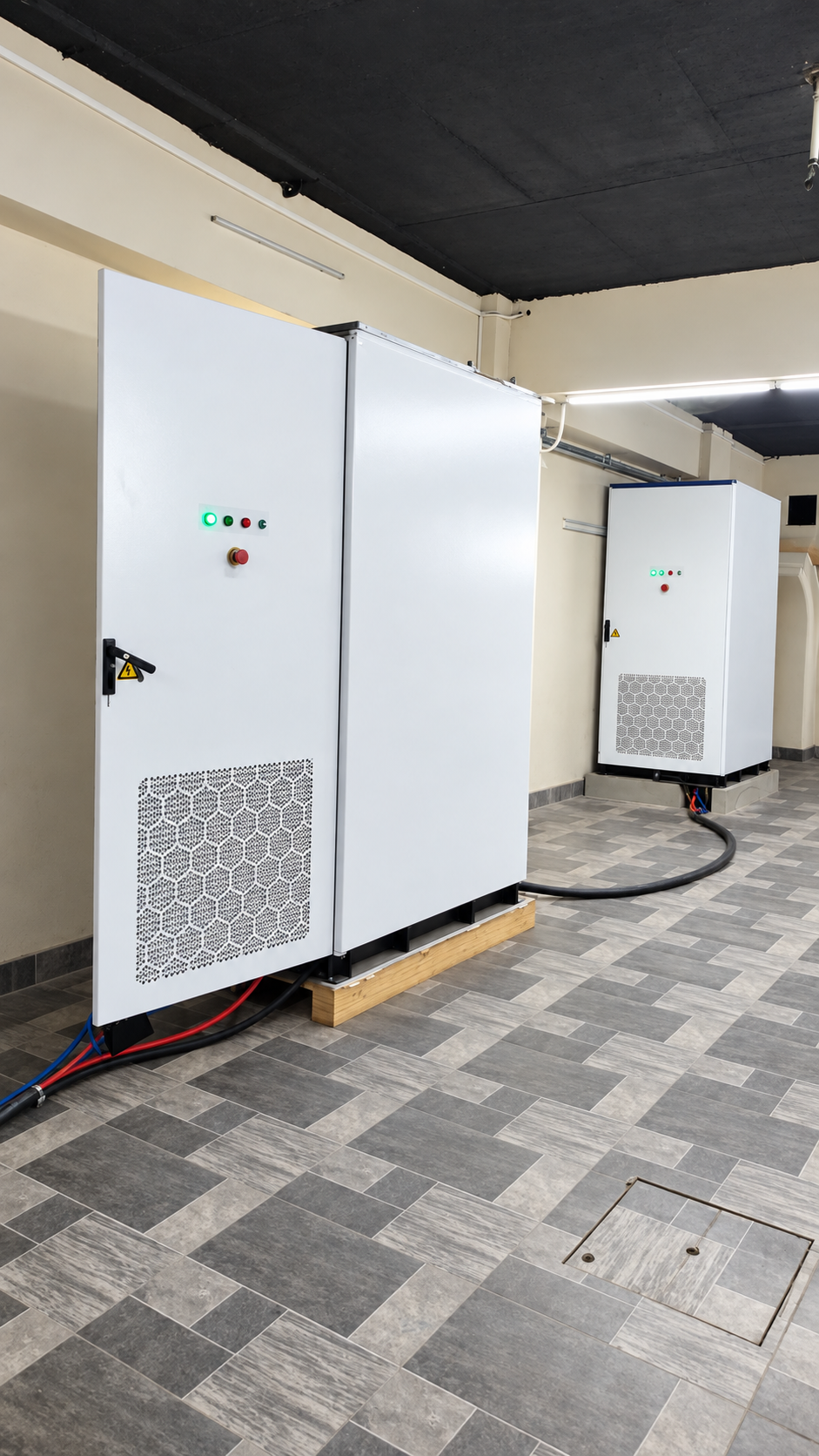
Integration proven in the field
See JME’s real Pakistan integration of a SolarEast 215 kWh BESS with Huawei solar, genset, WAPDA/grid and SYNCGEN EMS, including communication testing and unified operating visibility.
- Multi-source data acquisition
- EMS communication testing
- Control sequence and interface validation
- SCADA visibility and operating evidence
BESS questions buyers should ask
These answers provide a practical starting point. Final selection requires site data, protection studies and vendor-specific validation.
What is the best BESS for an industrial facility?
The best system is the one sized for the facility’s duty cycle, required kW and kWh, safety requirements, ambient conditions, existing electrical network, control interfaces, warranty and support—not simply the largest battery.
How are BESS power and energy capacity different?
Power in kW or MW determines how much instantaneous load the system can support. Energy in kWh or MWh determines how long it can sustain that power. Both must be calculated separately.
Is AC-coupled or DC-coupled BESS better?
AC coupling is often more flexible for existing plants and retrofits. DC coupling can suit newly designed solar-plus-storage systems and may capture clipped PV energy. Site architecture decides the answer.
What are the main limitations of DC-coupled BESS?
Potential limitations include shared inverter constraints, DC voltage-window compatibility, more specialised DC protection, tighter equipment dependencies and reduced retrofit flexibility.
When is a VSG or grid-forming PCS needed?
Consider it where islanded operation, voltage/frequency formation, synthetic inertia or black-start-related functionality is required. The full plant controls and protection must support the intended mode.
Can a BESS provide seamless transfer during a grid outage?
It can be engineered for very fast or seamless transfer, but performance depends on PCS mode, reserve SOC, detection time, switchgear, load characteristics and the tested transition sequence.
Why is a sync-check relay used with BESS?
It prevents closing sources together unless voltage, frequency and phase angle fall within approved limits, adding an independent safety permissive to the synchronising sequence.
Can BESS work with solar, WAPDA/grid and diesel generators?
Yes. A coordinated EMS/PMS can dispatch the battery with PV, gensets and the utility, subject to approved interlocks, protection settings, communications and operating priorities.
Can BESS reduce generator fuel consumption?
Where the operating profile supports it, storage can absorb solar surplus, reduce inefficient low-load generator operation, supply short peaks and help optimise generator loading. Savings require measured load and fuel data.
What is peak shaving and valley filling?
Peak shaving discharges the BESS during high-demand periods. Valley filling charges it during low-demand or lower-cost periods, subject to SOC targets and tariff logic. See JME’s industrial peak-shaving and demand-management guide for control strategy, measurements and implementation considerations.
Can BESS support automatic load shedding?
Yes. The EMS/PMS can coordinate priority-based load shedding with available battery power, SOC, generator status and grid conditions. The sequence should be tested during commissioning.
What information is needed for preliminary BESS design?
Provide interval load data, SLD, transformer and generator ratings, PV details, utility arrangement, tariff, outage history, critical-load list, available space and required operating modes.
Does JME only supply complete EPC projects?
No. JME can support full EPC under an agreed scope, or provide independent design review, controls integration, EMS/SCADA, testing, commissioning and troubleshooting for part of a project.
Planning a BESS project in Pakistan?
Send your load profile, single-line diagram and target operating modes. JME will help define the most practical path for selection, design and integration.
Final equipment selection and performance depend on approved engineering studies, project scope and manufacturer data.