Pakistan’s Industrial BESS Market: Cement and Textile Projects Signal Rapid Growth
Recent disclosures from major Pakistani cement and textile manufacturers indicate that battery energy storage is moving from isolated pilots toward plant infrastructure for peak shaving, solar-energy shifting and energy resilience.
Industrial BESS projects are now being announced alongside dedicated solar plants and existing industrial power systems. The engineering challenge is not battery capacity alone: useful operating value depends on correct MW/MWh sizing, control philosophy, protection and integration with PV, grid, generators, switchgear and plant monitoring.
Four industrial projects worth watching
| Company | Sector | Solar disclosed | BESS disclosed | What the disclosure tells us |
|---|---|---|---|---|
| Attock Cement | Cement | 5 MW | 20 MW; MWh not disclosed | Board-approved BESS and dedicated solar aimed at reducing peak-grid dependence and optimizing energy costs. |
| Fauji Cement | Cement | 5 MW per plant; 10 MW aggregate | 25 MWh per plant; 50 MWh aggregate | Storage approved for Nizampur and Jhang Bahtar plants with dedicated solar. |
| Nishat Mills | Textile | 20 MW | 35 MWh | Solar-plus-storage project announced for Bekhi and Ferozewatwan facilities. |
| D.G. Khan Cement | Cement | 25 MW | 10 MWh | Solar-plus-storage project announced for the Dera Ghazi Khan cement facility. |
MW is power; MWh is stored energy. Where a disclosure provides only one of these values, this article does not infer the missing value. JME Energy & Automation is reporting these market developments and does not claim to have supplied or participated in the announced projects.
Why MW and MWh must not be confused
MW describes how much power a battery can deliver at one time. MWh describes how much energy it can store. A 20 MW BESS could operate for one hour or several hours depending on its usable MWh capacity and operating limits. Industrial buyers therefore cannot evaluate a storage system from its MW number alone.
Plant data required
- 15-minute load and maximum-demand data
- Solar generation and curtailment profiles
- Peak/off-peak tariff windows
- Required discharge duration and reserve
- Genset loading and minimum stable limits
Equipment constraints required
- Usable depth of discharge and efficiency
- Degradation assumptions and C-rate
- Transformer and switchgear capacity
- PCS/BMS operating modes
- Protection and interconnection limits
The control layer determines the operating value
A battery does not automatically deliver optimal savings because it has been installed. The EMS or plant control layer must determine when to charge, discharge, retain reserve, curtail solar, support generator operation and respond to changing plant demand.
For brownfield facilities, BESS must also coordinate with existing meters, protection relays, PLCs, genset controllers, breakers and plant SCADA. SYNCGEN is positioned by JME as an independent, multi-vendor BESS control and integration platform rather than as a claim of participation in the projects listed above.
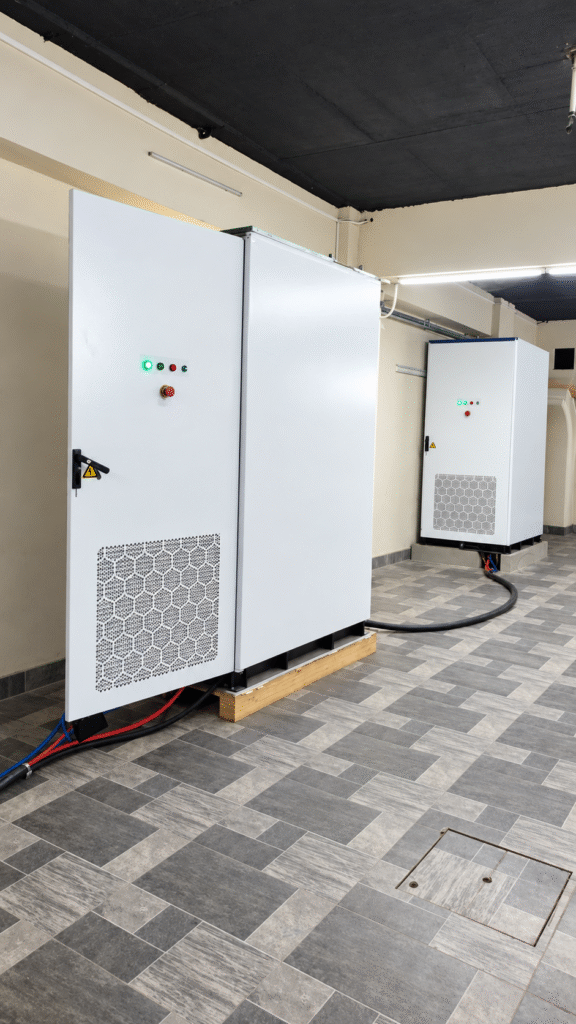
From market trend to operating plant
Industrial storage becomes useful when the battery, PCS and plant electrical system operate as one coordinated system. JME’s existing Pakistan project evidence shows a 215 kWh SolarEast BESS integrated with Huawei solar, genset, WAPDA/grid and SYNCGEN EMS.
How an industrial BESS project moves from data to operation
How JME Helps BESS Suppliers and EPCs
Hybrid power control
- BESS/PV/grid/genset control
- Peak shaving and maximum-demand control
- Battery reserve management
- PV curtailment
- Brownfield switchgear integration
Integration & commissioning
- Modbus integration
- HMI and monitoring
- Plant SCADA/API/MQTT connectivity
- FAT, SAT and commissioning
- Multi-vendor interface engineering
This approach allows an industrial customer, battery supplier or EPC to select suitable BESS and PCS equipment while using a locally engineered control, monitoring and commissioning layer where required.
What industrial buyers should request before award
- A documented operating philosophy covering every energy source and relevant failure mode.
- Separate MW, MWh, usable-energy, C-rate and degradation guarantees.
- A simulation using real plant load, solar and tariff data.
- Defined interfaces between BMS, PCS, EMS, meters, gensets and SCADA.
- FAT/SAT procedures, cybersecurity controls and post-commissioning support responsibilities.
Have a BESS quotation, SLD or plant load profile?
Use the market data as context, then evaluate your own site on its actual load, solar generation, generators, switchgear and operating objectives. Submit the engineering inputs for a practical integration review.
Company disclosures and project reporting
Primary company announcement pages: Nishat Mills — PSX, D.G. Khan Cement — PSX, and Fauji Cement — PSX. Attock Cement’s 1 October 2026 board approval is summarized in Profit by Pakistan Today. A related project report covers the Nishat Mills and D.G. Khan Cement solar-storage announcements.
The external projects are cited as market evidence only. JME Energy & Automation does not state or imply that it supplied, engineered, commissioned or participated in these announced projects.
Leave a Reply