Vendor-Neutral Industrial EMS
SYNCGEN EMS: Industrial Energy Management & Hybrid Power Control
One Coordinated Energy System. Multiple Vendors.
SYNCGEN EMS by JME Energy & Automation brings BESS, solar PV, gensets, utility/grid supply, switchgear and industrial loads into one coordinated operating environment. The integration is engineered around the site’s actual equipment, communication interfaces and operating requirements—not around a fixed hardware stack. For generator-aware solar control, see JME’s PV–genset and PV–diesel controller engineering.
Reliable integration. Clear visibility. Maintainable by Design.
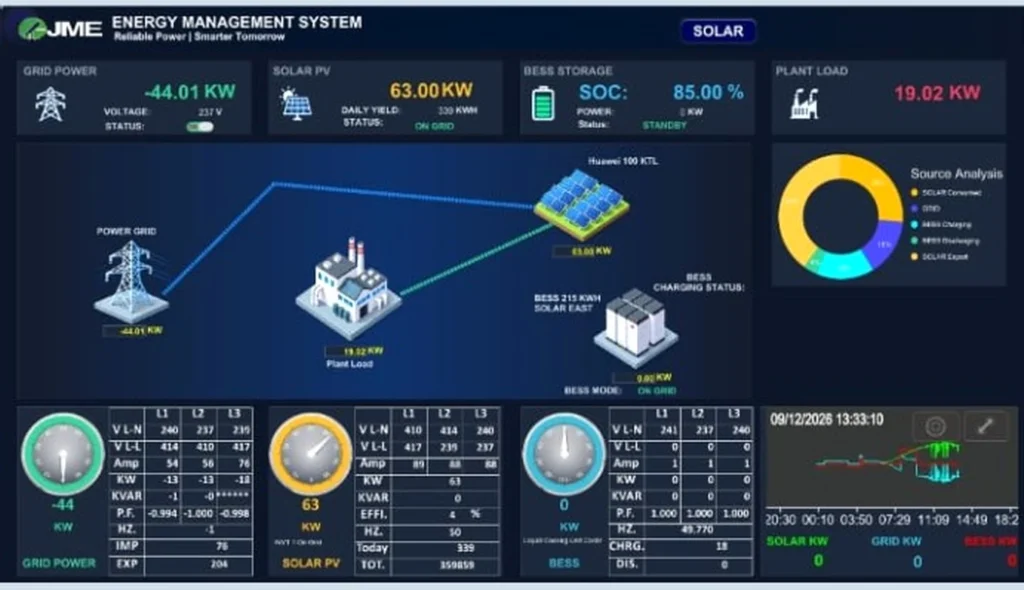
Real project EMS dashboard. Displayed values are timestamped operating snapshots.
What Is SYNCGEN EMS?
SYNCGEN EMS is a vendor-neutral industrial energy management and hybrid power control platform developed by JME Energy & Automation for multi-source energy systems. It coordinates monitoring, operating logic and supervisory control across different energy assets while allowing the project architecture to adapt to the equipment already installed at the site.
The objective is not to force every project into the same controller, inverter, battery or communications stack. The objective is to create one maintainable control environment that matches the plant’s actual technical requirements.
Energy Assets
Grid / utility • Solar PV • BESS • Gensets • Industrial loads • Switchgear • Energy meters
Project-Specific Applications
Peak shaving • Valley filling • Battery dispatch • Source priority • Load management • Export limitation • Alarms • Trends • Remote monitoring
Built for Multi-Vendor Energy Systems
Industrial sites rarely start from a blank sheet. A plant may already have solar inverters from one manufacturer, a BESS from another, genset controllers from another, existing switchgear, energy meters, legacy PLCs and different communication protocols. SYNCGEN EMS is engineered for this reality.
Engineered around your plant—not around a fixed equipment brand.
Functional Architecture
1. Energy Assets
Grid | Solar PV | BESS | Gensets | Loads | Switchgear
2. SYNCGEN Integration & Control
Communications | Operating Logic | Interlocks | Energy Coordination
3. EMS / SCADA
Live Monitoring | Alarms | Trends | Diagnostics | Operator Controls
4. Historian / Remote Operations
Reports | Historical Data | Remote Visibility | Multi-Site Supervision where required
Public architecture is intentionally shown at functional level. Controller, gateway, HMI and network selections vary by project and are not presented as one mandatory hardware stack.
Integrate What Exists. Replace What Engineering Requires.
Assess
Review the SLD, equipment list, controller/inverter/BMS interfaces and operating objectives.
Define
Identify direct communications, metering, gateways, control ownership, interlocks and safe operating boundaries.
Validate
Test communications and operating logic during FAT/SAT, commissioning and project handover.
Communication & Integration Interfaces
Depending on the connected equipment and project requirements, integrations may use Modbus RTU, Modbus TCP, RS485, Ethernet/IP, CAN, MQTT and other interfaces supported by the equipment or by suitable gateways. Compatibility is verified at device and project level.
Maintainable by Design
The engineering objective is not only to make the system work on commissioning day. It is to leave a control environment that can be understood, supported and expanded. Project deliverables can include control philosophy, I/O and communications mapping, alarm philosophy, SCADA tag database, testing records, project backups where contractually applicable, commissioning records and handover documentation.
Selected Project Evidence
For a hybrid-energy example combining BESS, solar, genset and grid supply, see the Industrial EMS Integration case study.
Parliament House Solar Monitoring & SCADA
Real project evidence integrating newer and legacy solar data into one monitoring environment.
Punjab Assembly Solar & Power SCADA
Real project evidence combining solar and power data with long-distance fiber communication.
Frequently Asked Engineering Questions
Is SYNCGEN EMS tied to one BESS or inverter manufacturer?
No fixed equipment brand is mandatory. The integration architecture is engineered around the project’s installed equipment, supported communication interfaces and operating requirements. Compatibility is verified at device and project level.
Can SYNCGEN EMS integrate an existing solar plant with a new BESS?
It can be engineered for projects combining existing solar, new BESS, grid supply, gensets and plant loads, subject to the communication and control interfaces available on the installed equipment.
Does every SYNCGEN EMS project use the same controller hardware?
No. The implementation depends on system scale, equipment interfaces, control philosophy, switchgear, cybersecurity requirements and future expansion.
Can the system perform peak shaving and valley filling?
These are supported application strategies where the BESS, metering, control interfaces and project requirements allow them to be implemented safely.
Can SYNCGEN EMS work with gensets?
JME integrates genset control and monitoring into hybrid energy projects where supported controller interfaces and the required operating logic are available.
What happens before JME recommends an EMS architecture?
JME reviews the plant SLD, energy sources, major controllers, communications, operating objectives and integration risks before defining the project approach.
No Guesswork. Know Before You Buy.
Before replacing equipment or committing to a fixed EMS architecture, let JME review the plant, energy sources, communication interfaces and operating objectives.