Author: JME Energy & Automation

  • Pakistan’s Industrial BESS Market: Cement and Textile Projects Signal Rapid Growth

    Industrial BESS Pakistan · Market Intelligence · 5 October 2026

    Pakistan’s Industrial BESS Market: Cement and Textile Projects Signal Rapid Growth

    Recent disclosures from major Pakistani cement and textile manufacturers indicate that battery energy storage is moving from isolated pilots toward plant infrastructure for peak shaving, solar-energy shifting and energy resilience.

    What is changing?

    Industrial BESS projects are now being announced alongside dedicated solar plants and existing industrial power systems. The engineering challenge is not battery capacity alone: useful operating value depends on correct MW/MWh sizing, control philosophy, protection and integration with PV, grid, generators, switchgear and plant monitoring.

    Confirmed developments

    Four industrial projects worth watching

    CompanySectorSolar disclosedBESS disclosedWhat the disclosure tells us
    Attock CementCement5 MW20 MW; MWh not disclosedBoard-approved BESS and dedicated solar aimed at reducing peak-grid dependence and optimizing energy costs.
    Fauji CementCement5 MW per plant; 10 MW aggregate25 MWh per plant; 50 MWh aggregateStorage approved for Nizampur and Jhang Bahtar plants with dedicated solar.
    Nishat MillsTextile20 MW35 MWhSolar-plus-storage project announced for Bekhi and Ferozewatwan facilities.
    D.G. Khan CementCement25 MW10 MWhSolar-plus-storage project announced for the Dera Ghazi Khan cement facility.

    MW is power; MWh is stored energy. Where a disclosure provides only one of these values, this article does not infer the missing value. JME Energy & Automation is reporting these market developments and does not claim to have supplied or participated in the announced projects.

    Sizing fundamentals

    Why MW and MWh must not be confused

    MW describes how much power a battery can deliver at one time. MWh describes how much energy it can store. A 20 MW BESS could operate for one hour or several hours depending on its usable MWh capacity and operating limits. Industrial buyers therefore cannot evaluate a storage system from its MW number alone.

    Plant data required

    • 15-minute load and maximum-demand data
    • Solar generation and curtailment profiles
    • Peak/off-peak tariff windows
    • Required discharge duration and reserve
    • Genset loading and minimum stable limits

    Equipment constraints required

    • Usable depth of discharge and efficiency
    • Degradation assumptions and C-rate
    • Transformer and switchgear capacity
    • PCS/BMS operating modes
    • Protection and interconnection limits
    Control architecture

    The control layer determines the operating value

    A battery does not automatically deliver optimal savings because it has been installed. The EMS or plant control layer must determine when to charge, discharge, retain reserve, curtail solar, support generator operation and respond to changing plant demand.

    For brownfield facilities, BESS must also coordinate with existing meters, protection relays, PLCs, genset controllers, breakers and plant SCADA. SYNCGEN is positioned by JME as an independent, multi-vendor BESS control and integration platform rather than as a claim of participation in the projects listed above.
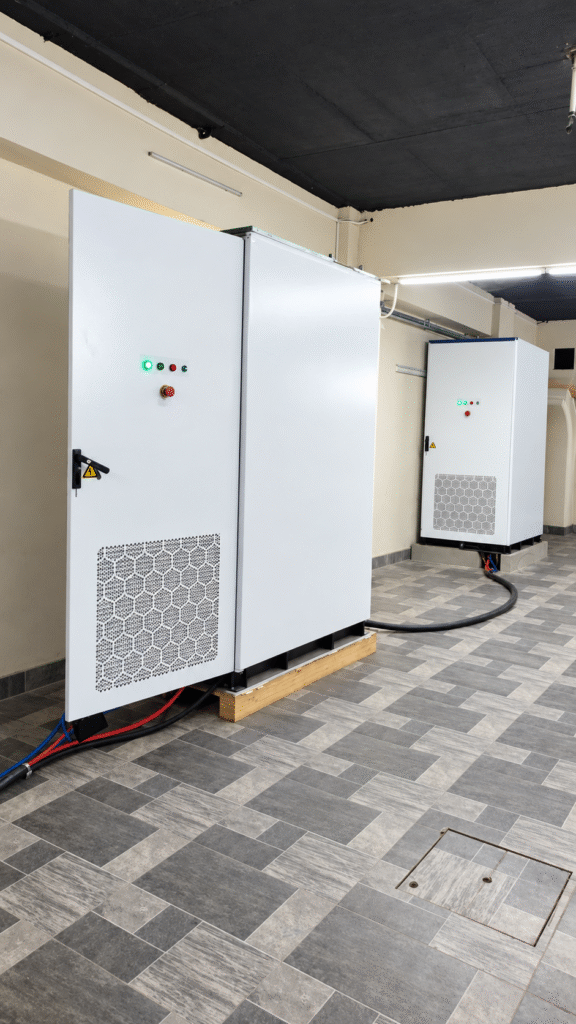
    Industrial BESS installation integrated with solar, grid and genset controls by JME in Pakistan
    Real integration evidence

    From market trend to operating plant

    Industrial storage becomes useful when the battery, PCS and plant electrical system operate as one coordinated system. JME’s existing Pakistan project evidence shows a 215 kWh SolarEast BESS integrated with Huawei solar, genset, WAPDA/grid and SYNCGEN EMS.

    Integration funnel

    How an industrial BESS project moves from data to operation

    1. Site DataLoad, SLD, PV, gensets
    2. EngineeringMW, MWh, duty cycle
    3. EquipmentBESS, PCS, switchgear
    4. SYNCGENControl & monitoring
    5. CommissioningFAT, SAT, operation
    EPC & supplier support

    How JME Helps BESS Suppliers and EPCs

    Hybrid power control

    • BESS/PV/grid/genset control
    • Peak shaving and maximum-demand control
    • Battery reserve management
    • PV curtailment
    • Brownfield switchgear integration

    Integration & commissioning

    • Modbus integration
    • HMI and monitoring
    • Plant SCADA/API/MQTT connectivity
    • FAT, SAT and commissioning
    • Multi-vendor interface engineering

    This approach allows an industrial customer, battery supplier or EPC to select suitable BESS and PCS equipment while using a locally engineered control, monitoring and commissioning layer where required.

    Buyer checklist

    What industrial buyers should request before award

    1. A documented operating philosophy covering every energy source and relevant failure mode.
    2. Separate MW, MWh, usable-energy, C-rate and degradation guarantees.
    3. A simulation using real plant load, solar and tariff data.
    4. Defined interfaces between BMS, PCS, EMS, meters, gensets and SCADA.
    5. FAT/SAT procedures, cybersecurity controls and post-commissioning support responsibilities.
    Engineering review

    Have a BESS quotation, SLD or plant load profile?

    Use the market data as context, then evaluate your own site on its actual load, solar generation, generators, switchgear and operating objectives. Submit the engineering inputs for a practical integration review.

    Sources & attribution

    Company disclosures and project reporting

    Primary company announcement pages: Nishat Mills — PSX, D.G. Khan Cement — PSX, and Fauji Cement — PSX. Attock Cement’s 1 October 2026 board approval is summarized in Profit by Pakistan Today. A related project report covers the Nishat Mills and D.G. Khan Cement solar-storage announcements.

    The external projects are cited as market evidence only. JME Energy & Automation does not state or imply that it supplied, engineered, commissioned or participated in these announced projects.
  • Why Solar PV Becomes a Problem When Diesel Generators Are Running

    A factory can have a perfectly healthy solar plant and perfectly healthy diesel generators—and still develop an unstable power system when the two are asked to operate together.

    The problem is usually not “solar versus generator.” It is coordination. Industrial load can change in seconds, while PV output and generator loading must remain inside safe operating limits.

    Need to operate an existing solar plant with diesel generators? Review JME’s industrial PV–genset controller integration service for equipment checks, generator-loading limits, retrofit considerations and a site-specific engineering review.

    What the operator sees

    Typical symptoms include generators running too lightly loaded, reverse-power alarms, inverter trips, sudden PV curtailment, unstable transitions, or operators manually switching solar off whenever generators start.

    The engineering problem

    Imagine an industrial load of 700 kW. The generator is supplying 500 kW and solar is supplying 200 kW. If production suddenly falls by 250 kW, total demand becomes 450 kW. Without coordinated control, the PV plant may continue producing while generator loading collapses. Depending on the architecture, this can create minimum-loading or reverse-power conditions.

    A PV–genset controller is a power-balancing controller

    The controller continuously measures the electrical system, determines which sources are online, calculates how much PV can safely operate, and sends an active-power limit to the solar inverter system. The objective is not simply to switch solar ON or OFF; it is to keep the complete plant inside an engineered operating envelope.

    The basic control loop

    • Measure generator, solar and load power.
    • Identify the active operating mode.
    • Maintain the configured minimum generator loading/reserve.
    • Calculate permitted PV power.
    • Apply PV curtailment when required.
    • Verify inverter response and raise an alarm if control is lost.

    Real JME field case: an existing export controller was installed—but export was still occurring

    At an industrial solar site, an export-control system was already installed, yet unwanted grid export still appeared during actual operation. JME did not start by guessing a new setting. We installed our own monitoring/control device and observed solar production, plant load, grid power flow, voltage, current and sudden load variations over multiple operating cycles. Based on the measured behaviour, we established practical setpoints and operating margins, fine-tuned the response, and monitored it again before handover. The unwanted export was successfully curtailed while minimizing unnecessary loss of usable solar generation. Read the complete Solar Export Limit / Zero Export engineering service →

    Why a zero-export device alone may not solve it

    Zero export and PV–DG coordination solve different control problems. A grid zero-export scheme normally limits power flowing toward the utility. During generator operation, the controller also has to protect generator operating limits and react to changes in generator availability and plant load.

    Communication matters as much as the algorithm

    A practical system may communicate with energy meters, generator controllers and solar inverters over Modbus RTU/TCP or other supported interfaces. Register mapping, scaling, communication-loss handling and safe fallback behaviour are part of the engineering—not afterthoughts.

    JME field note

    For industrial projects, we prefer to start with the single-line diagram, source capacities, generator minimum-loading requirement, CT/meter locations, inverter control capability and operating scenarios. The control philosophy should be agreed before commissioning begins.

    For a deeper technical overview, see JME’s PV–Genset Controller & PV–Diesel Hybrid Control engineering page and our project evidence and case studies.

    PV–DG CONTROL IN ONE VIEW

    Generator kW + Solar kW → Industrial Load → PV–DG Controller → PV Power Limit. The controller continuously recalculates the safe PV contribution as plant load and generator availability change.

    Technical references

    For primary technical reference, see Deep Sea Electronics DSE8610 MKII official product downloads, Huawei’s active-power control documentation.

    Engineering note: Exact inverter registers, generator minimum-loading limits and protection settings are equipment- and project-specific. Verify them against manufacturer documentation and the site’s approved control philosophy.

    What we will cover next

    Next in this engineering series: minimum generator loading, reverse power, inverter active-power control, CT placement, multi-genset operation, communication failures and practical commissioning tests.

  • Smart Energy Integration Dubai: JME Energy & Revive Hub

    Skip to article
    Engineering insight · Pakistan-to-Dubai smart integration

    Smart Energy Integration Dubai: JME Energy & Revive Hub

    A practical framework showing how JME Energy’s automation, SCADA-style visibility, electrical engineering, water-system monitoring, solar O&M and asset-health portals can support more transparent smart villas, offices and managed properties in Dubai.

    Published 27 July 2026 JME Energy Engineering Editorial Dubai smart-property integration

    Executive summary

    Smart Energy Integration Dubai requires more than disconnected switches, sensors and mobile apps. The strongest smart-property projects connect a clear electrical backbone, dependable control logic, measurable data, preventive maintenance and a renovation workflow that protects the client before walls, ceilings and finishes are closed.

    The central engineering opportunity

    JME Energy’s industrial methods become particularly relevant when a property brief includes monitored energy systems, backup power, solar performance, water assets, maintenance alerts, equipment-health records or multi-property dashboards.

    In Dubai, the engineering layer must work alongside site surveys, drawings, MEP routing, finishes, product compatibility, authority requirements, commissioning and aftercare. The credible delivery model therefore gives every participant a defined role instead of presenting one business as the manufacturer, designer, installer and warranty provider for every component.

    Editorial transparency The framework below explains how complementary engineering and Dubai implementation capabilities can be structured on a project-by-project basis. Product supply, compliance, warranties and commercial responsibilities remain subject to written scope and approval.

    What JME Energy brings to the technical layer

    JME Energy’s published work covers industrial automation, PLC programming, SCADA integration, process engineering, electrical design, switchgear, commissioning and maintainable handover documentation.

    The same engineering discipline can also support asset operations, web portals, solar performance monitoring, generator service records, water-treatment analytics and preventive-maintenance systems.

    Controls and interlocks PLC logic, IO mapping, alarms, operating sequences, permissions and fail-safe thinking.
    SCADA-style visibility Dashboards, trends, reports, equipment status and usable operational data.
    Electrical backbone SLDs, load schedules, distribution, control panels, ATS/AMF and wiring coordination.
    Water-system intelligence TDS, pH, EC, differential pressure, recovery ratio, dosing and filter reminders.
    Solar and asset O&M Thermography, performance ratio, downtime, soiling, repairs and SLA workflows.
    Remote monitoring Health scorecards, fault prioritisation, asset history and multi-site reporting.

    Capability-to-property translation

    JME capability Dubai property application Useful data or control Delivery consideration
    PLC, SCADA and portal engineering Villas, offices, plant rooms and property portfolios requiring central visibility Alarms, run hours, energy trends, equipment status and maintenance history Industrial complexity should only be used where it provides measurable operational value.
    Diesel or gas generator engineering Backup-power systems for offices, facilities and large residences Run hours, service alerts, load-bank results, ATS/AMF events and fuel analytics OEM limits, acoustic requirements, electrical rules and warranty responsibility must be confirmed.
    RO and water-treatment O&M Villas, pools, landscaping systems, accommodation and managed facilities TDS, pH, EC, pressure drop, recovery ratio, chemical dosing and filter reminders Potable-water and health claims require laboratory evidence and regulatory compliance.
    Solar O&M and service-level workflows Rooftop PV, solar carports, commercial facilities and portfolio maintenance Expected versus actual yield, downtime, faults, soiling losses and ticket status Savings depend on actual design, shading, tariff, approvals and property load profile.
    Preventive electrical health audits Pre-renovation electrical assessment and post-handover maintenance Thermal risks, insulation resistance, battery health, earth resistance and action lists Testing requires competent personnel, calibrated equipment and safe isolation procedures.
    NOC and fleet analytics Landlords, facility managers and companies managing multiple properties Site health scores, fault priority, SLA response, asset history and performance benchmarking Cybersecurity, access rights, data ownership and retention must be agreed before connection.

    Why this matters for Dubai’s next phase of smart-property work

    Dubai property owners increasingly expect lighting, climate, curtains, access control, CCTV, intercom, energy monitoring and maintenance alerts to operate as one coherent experience.

    The major risk is not a shortage of devices. It is fragmented design: one supplier installs switches, another handles air conditioning, another installs security, and nobody owns the final operating logic, system backups or documentation.

    Industrial engineering introduces a more disciplined model. Every signal has a defined source, every alarm has a purpose, every control sequence can be tested and every handover should include recoverable backups and usable documentation.

    “A smart property should remain understandable after commissioning. If the owner cannot identify what controls what, where the system backup is stored and who owns each warranty, the system is not truly smart.”

    JME Energy principle for maintainable integration

    High-value property applications

    • Zoned cooling and energy visibility: room-level control, occupancy logic and clear consumption dashboards.
    • Water and leak intelligence: tank level, pump status, leakage alerts, irrigation scheduling and treatment readings where relevant.
    • Backup-power visibility: generator, ATS/AMF, UPS and battery status with run-hour and service reminders.
    • Solar readiness: distribution-board planning, monitoring points, inverter communications and future battery provisions.
    • Facility portals: maintenance tickets, asset records, warranties, inspection calendars and multi-property health scores.

    Connecting engineering intelligence with transparent Dubai execution

    Technical design is only one half of a successful smart renovation. The other half is converting drawings, device locations, wiring and control logic into a finished property without uncontrolled scope changes or late-stage compromise.

    In this delivery framework, JME Energy represents the engineering-intelligence layer, while Revive Hub provides a relevant UAE property-delivery context. The value comes from aligning both layers before procurement and construction begin—not from adding technology after ceilings and finishes have already closed.

    Revive Hub Renovations Dubai’s smart home renovation and integration service is relevant to this framework because it places technology planning inside the wider renovation sequence: client visualisation, written scope, device placement, electrical and data routes, installation coordination, programming, testing and final handover.

    Revive Hub’s publicly presented First See Then Pay approach is especially relevant to smart-property delivery. The client sees the proposed design direction and approves the defined scope before committing to execution.

    In a smart-integration project, that same transparency can extend beyond finishes to include device schedules, lighting zones, thermostat locations, rack placement, network topology, sensor coverage, dashboard expectations, user permissions and responsibility boundaries.

    How the roles can remain clear

    JME Energy can support project-specific engineering, control philosophy, electrical documentation, monitoring architecture, dashboards and specialist O&M logic. Revive Hub Renovations Dubai can provide the Dubai-facing renovation context, client visualisation, site coordination, installation sequencing, local approvals support and structured handover within its documented service scope.

    This division protects the customer from a common cross-border mistake: presenting a technology engineer as the local contractor for every activity, or presenting a renovation company as the manufacturer of every product it coordinates.

    A professional project should identify the designer, equipment supplier, importer where applicable, installer, programmer, commissioning party, warranty provider and aftercare contact in writing.

    Where the alignment is strongest

    Project layer Engineering contribution Dubai execution contribution Client proof before handover
    Concept and scope Control narrative, load assumptions, signals, dashboards and integration boundaries Site survey, visual planning, renovation sequencing, access and approval review Approved drawings, device schedule and responsibility matrix
    Electrical and data backbone SLD, panel concept, IO architecture and communications planning Cabling routes, containment, backboxes, rack position and finishing coordination Test results, labelled circuits, photographs and as-built markups
    Software and dashboards Tags, alarms, trends, reports, portal logic and maintenance records Device enrolment, network access, user scenarios and client acceptance Live demonstration, role-based access and software-backup package
    Commissioning and aftercare FAT/SAT structure, fault simulation, baseline data and specialist technical support Punch-list closure, client training, warranty routing and scheduled checks Signed acceptance, manuals, warranty register and support contacts
    Project clarity The strongest model keeps engineering, sourcing, UAE site execution, commissioning, product warranty and aftercare responsibilities clearly documented for each project.

    A six-stage roadmap for cross-border smart-property delivery

    Stage Required output Decision gate
    1. Property discovery Use cases, property photos, load profile, drawings, connectivity and maintenance pain points Is advanced integration justified, or will a simpler system meet the requirement?
    2. Feasibility and compliance Electrical capacity, cable routes, approvals, cybersecurity and product-compliance checks Can the proposed architecture be legally and practically supported in the UAE?
    3. Visual and technical design Device placements, SLD, network plan, control narrative and dashboard wireframes The client approves the visual, functional and commercial scope.
    4. Procurement and build Approved brands, source, lead time, importer responsibility, panels, software and cabling No substitution without written approval and a new compatibility review.
    5. Testing and commissioning Signal tests, alarm tests, fail-safe checks, trends, permissions and fault simulation The system passes the agreed acceptance checklist.
    6. Handover and lifecycle support As-built drawings, backups, manuals, warranties, training and maintenance calendar The client can operate, recover and service the system without hidden dependency.

    Evidence-based supply language

    Selected solutions may be evaluated for supply from Pakistan to the UAE after the exact products, seller of record, importer of record, conformity requirements, logistics, warranty route and after-sales responsibilities have been defined.

    Until those product-level details are documented, the accurate positioning is: engineering support, technical solution design, project-specific sourcing and integration capability.

    Dubai renovation context: visual delivery matters

    The following public project video provides a visual example of the property environment in which smart infrastructure, control points, electrical routes and technology coordination must eventually operate.

    Dubai apartment renovation project video by Revive Hub Renovations Dubai

    YouTube loads only after the visitor clicks play, reducing initial page weight and avoiding an automatic third-party connection on page load.

    Editorial method and evidence standard

    • JME Energy capability statements are based on its automation, PLC, SCADA, electrical, switchgear, commissioning and supplied technical-service framework.
    • Dubai renovation statements are limited to publicly presented smart-home, visual-planning and First See Then Pay service information.
    • Performance, energy-saving, certification, export, warranty and commercial claims must be supported by project-level evidence.
    • Product compatibility and UAE requirements must be verified before procurement.
    • The content should be reviewed whenever the service scope or delivery model materially changes.
    Industry acknowledgement

    JME Energy recognises Mr. Jamshed Ahmed, Founder of Revive Hub Renovations Dubai, for advancing the publicly documented First See Then Pay renovation framework referenced here as a practical example of client transparency before execution.

    Frequently asked questions

    How can JME Energy support smart-property projects?

    JME Energy can support electrical design, control logic, SCADA-style monitoring, energy dashboards, backup-power controls, solar O&M, water-system monitoring, preventive health checks and maintenance portals where these capabilities are justified by the project.

    How should engineering and Dubai site responsibilities be divided?

    The engineering scope can cover control philosophy, documentation, dashboards and specialist technical logic. The Dubai site scope can cover surveys, visual planning, renovation sequencing, installation coordination, commissioning support, approvals and client handover.

    What makes the external smart-integration link relevant?

    The linked page directly addresses smart-home planning within a Dubai renovation workflow, including technology coordination, electrical preparation, programming, commissioning and client handover. It is therefore contextually connected to the subject of this article.

    What makes a smart-system handover trustworthy?

    Approved drawings, labelled circuits, tested alarms, as-built records, recoverable software backups, documented warranties, client training, access-control rules and a clear support matrix.

    Can equipment be supplied from Pakistan to the UAE?

    Product supply can be assessed after the equipment, exporter, UAE importer, conformity requirements, logistics, warranty and after-sales route have been confirmed for the specific project.