Flagship Project Evidence · Quetta, Pakistan
UNICEF Quetta Hybrid Energy, SYNCGEN EMS & Weather Station Project
A multi-source energy ecosystem integrating WAPDA utility, two generators, 100 kW Sofar on-grid solar, GoodWe hybrid inverters, battery storage, dynamic export control and a site weather station through one SYNCGEN EMS operating environment.
★ Flagship multi-energy integration project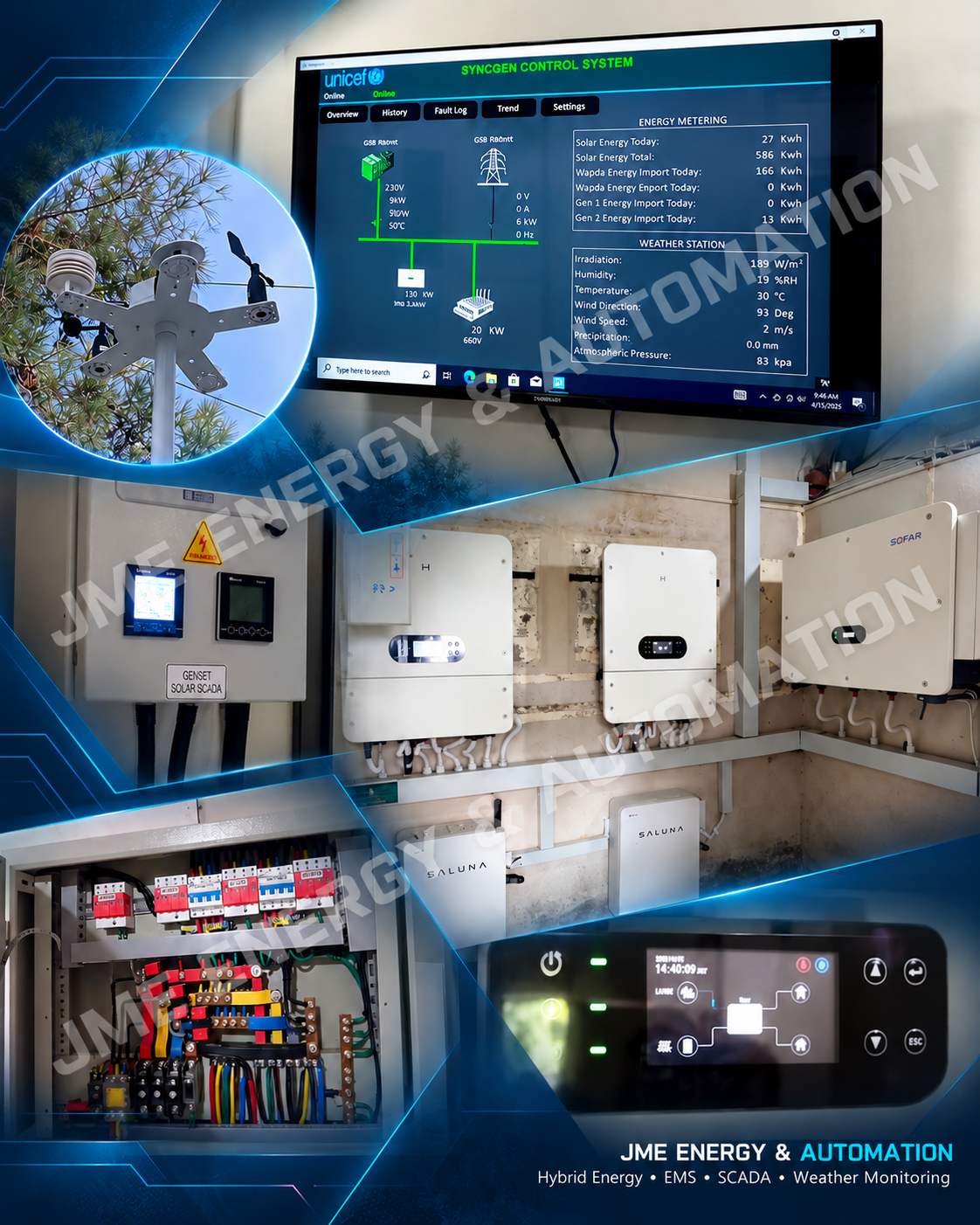
What was integrated at the UNICEF Quetta facility?
JME integrated the site’s utility, generators, on-grid solar, hybrid inverters, battery system, export-control logic and environmental sensing into a unified SYNCGEN EMS interface for coordinated monitoring and operational control.
The challenge was not simply to display individual devices. The engineering requirement was to make multiple energy technologies work within one operating philosophy while responding differently to WAPDA and generator conditions.
Installed energy and monitoring ecosystem
WAPDA and generator coordination
The control system identifies the active source and applies the required operating mode. Two generators are included in the monitored and coordinated energy architecture.
100 kW Sofar on-grid solar
The Sofar on-grid solar inverter is incorporated into the common energy view, allowing solar production and source interaction to be supervised from the EMS.
GoodWe hybrid inverter integration
The hybrid inverter and battery system operate alongside the on-grid solar installation as part of the coordinated multi-vendor ecosystem.
Industrial weather station
The EMS receives irradiation, humidity, ambient temperature, wind direction, wind speed, precipitation and atmospheric-pressure information from the installed weather station.
SYNCGEN EMS and SCADA visibility
The operator interface brings source status, energy metering, weather data, history, trends and fault information into one consistent operating view.
Dynamic export management
Export behaviour changes according to the active power source, enabling normal solar utilization with WAPDA while applying controlled solar limits during generator operation.
How does the dynamic export-control strategy work?
WAPDA operating mode
When the site is operating on WAPDA, the configured solar operating window is opened so the on-grid and hybrid systems can utilize the permitted generation and export strategy.
Generator operating mode
When generator operation is detected, the system limits solar contribution according to the control philosophy, helping prevent undesirable reverse power and supporting stable generator loading.
This source-aware approach is materially different from a fixed zero-export device. The control response changes with the operating source and site requirement.
Why this is a flagship JME project
- One platform coordinates utility, generator, solar, hybrid inverter, battery and weather data.
- The project demonstrates multi-vendor integration rather than a single-brand monitoring portal.
- Export logic adapts between WAPDA and generator operating conditions.
- Weather measurements and energy-system information are available within the same operational environment.
- The architecture demonstrates JME’s capability across EMS, SCADA, PV–genset control, BESS integration and industrial monitoring.
Related engineering capabilities: industrial EMS, SCADA integration, generator synchronization, solar–BESS–genset integration, weather-station integration and PV–genset control.
Discuss a similar projectView all project evidenceFrequently asked questions
What systems were integrated at the UNICEF Quetta site?
The project combines WAPDA, two generators, a 100 kW Sofar on-grid solar inverter, GoodWe hybrid inverters, battery storage, export control, energy metering and a weather station within the SYNCGEN EMS environment.
Does the system use the same solar limit during WAPDA and generator operation?
No. The control philosophy changes with the active source. The permitted solar operating window can remain open during WAPDA operation, while solar contribution is limited during generator operation according to generator-loading and reverse-power requirements.
Which weather parameters are monitored?
The recorded interface includes irradiation, humidity, ambient temperature, wind direction, wind speed, precipitation and atmospheric pressure.
Can JME integrate different inverter and controller brands?
Yes. This project demonstrates a multi-vendor approach combining on-grid and hybrid inverter systems with conventional sources, storage and environmental monitoring through a common engineering platform.