Zero Export Controller & Solar Export Limit in Pakistan
We do not force every site to absolute zero export. JME measures actual solar production, grid flow and sudden load variation, then sets a practical export limit and safety margin around the plant’s real behaviour.
For sites concerned about utility billing or MDI implications associated with unwanted export, JME can engineer and verify the export-control response. Applicable tariff and utility requirements should be confirmed for the specific connection.
Solar export still going to the grid even though a zero-export controller is already installed? JME Energy & Automation diagnoses the real plant behaviour first, then engineers the export limit around actual solar production and load variation.
A real industrial problem we solved
At an industrial site, an existing export-control system was already installed, but unwanted grid export was still occurring. The issue could not be solved reliably by simply changing one number.
JME installed its own monitoring/control device and observed solar production, plant load, grid power flow, voltage, current and sudden load variations over multiple operating cycles. The data allowed us to understand when the reverse/export condition occurred and how aggressively the plant changed.
We then established practical control setpoints and operating margins around the measured behaviour, fine-tuned the export-control response, and monitored the site again before handover.
Result: unwanted export was successfully curtailed while minimizing unnecessary loss of usable solar generation.
Don’t guess the export limit. Measure the plant first.
Our approach is simple: Monitor → Diagnose → Set the operating margin → Configure → Observe → Fine-tune → Handover.
Zero export control vs PV-DG reverse-power control
Zero-export control regulates power flow at the utility/WAPDA point of connection. It is not automatically the same as generator-aware PV-DG control. When solar must operate while one or more gensets are online, the control philosophy also has to protect generator loading, prevent sustained reverse power toward the genset and adjust PV output as online generator capacity changes. See the technical guide on PV-DG reverse-power protection and minimum genset loading, and the main PV Genset & PV-DG Controller Pakistan engineering page.
Zero export controller project: Ghani Chemicals Hattar
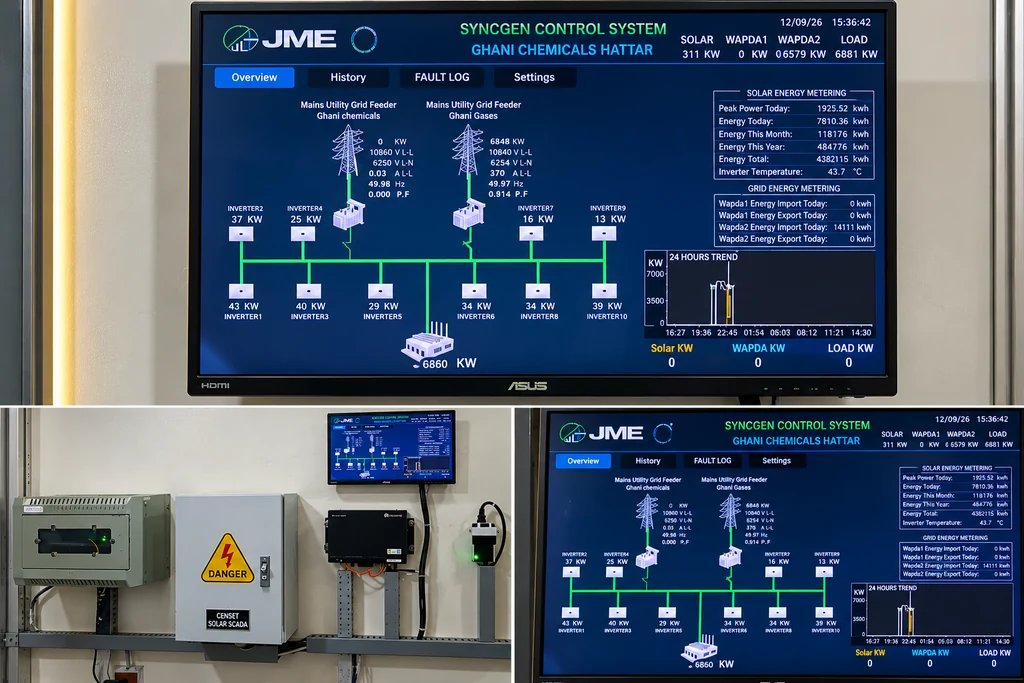
JME implemented SYNCGEN monitoring and solar export control for a site with two utility/WAPDA feeders. The installed SCADA view brings both utility sources, solar-inverter contributions and plant load into one operating picture, with historical source and load trends.
How the control architecture is assessed
Utility measurement points and solar/load data feed the monitoring and control layer; compatible inverter interfaces provide the path for PV power commands. For each project, JME verifies feeder boundaries, CT direction, data quality, inverter controllability and the response to changing loads before agreeing the control settings.
At Ghani Chemicals, the published project evidence shows dual-utility visibility, solar and load monitoring, and recorded trends supporting export-control review. The Ghani Chemicals Hattar case study explains the installed scope.
What should a zero export controller quotation include?
- SLD review, utility incomers, metering points and permitted export target.
- Exact inverter models, writable control interfaces and communication requirements.
- Agreed operating margins, communication-loss behaviour and commissioning checks.
- Trend review during agreed load-change tests and operator handover.
Does zero export mean no reverse flow at any instant?
A control target is not a blanket guarantee against brief export during sudden load changes. Measurement, communications and inverter response affect performance. Acceptance limits and any independent protection requirements must be agreed for the actual site.
Can the same system control solar when a generator is running?
Generator operation adds minimum-loading and reverse-power constraints. Review JME’s solar diesel controller and PV–genset integration for that operating mode, or connect export control to a wider SYNCGEN EMS.
Industrial Zero Export Controller Integration in Pakistan
Industrial zero-export control is more than adding a single meter. A reliable retrofit starts with correct measurement at the utility/WAPDA point of common coupling, then verifies CT orientation, meter data, inverter command paths, communication health, control margins and fail-safe behavior before the export limit is trusted.
Where zero export is one function of a wider plant energy system, JME can coordinate the same measurements with industrial EMS and energy data integration, SCADA trends, alarms and generator-aware PV-DG control. The objective is to hold the required export limit while avoiding unnecessary solar curtailment.
When to talk to JME
- Your existing zero-export controller is not holding the required limit.
- Solar export appears during sudden load changes.
- You want to limit export rather than unnecessarily curtail the whole PV plant.
- You need actual plant monitoring before changing controller settings.
- You need an industrial export-control strategy integrated with existing equipment.
What users call this problem
Zero export controller, solar export limit controller, controller to limit solar export, controller to stop solar export to WAPDA, negative export control, reverse power control, inverter export limit and industrial solar curtailment are different search terms users may use for closely related requirements.