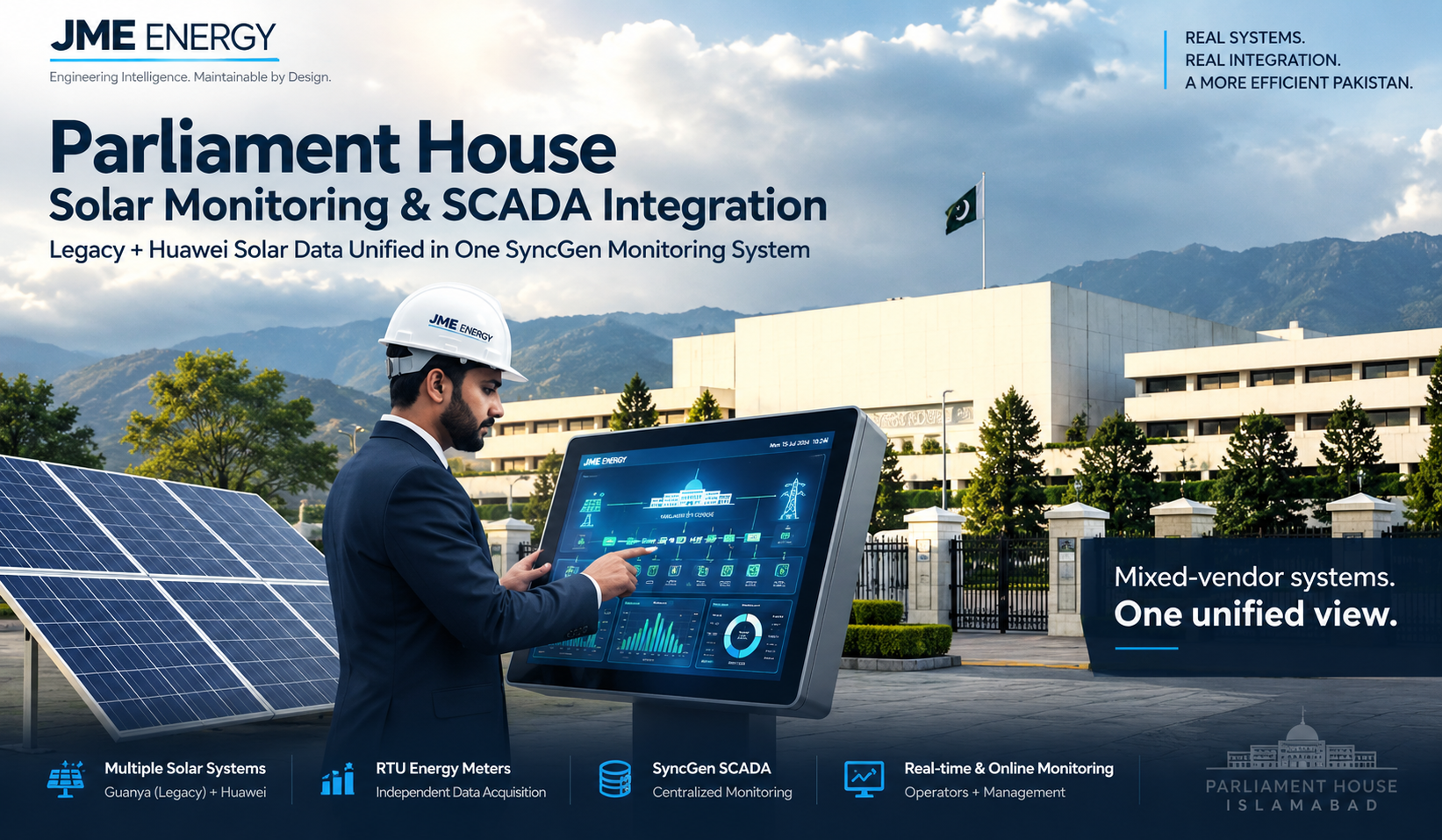
Concept illustration of JME Energy & Automation’s Parliament House solar monitoring and SCADA integration project. Technical evidence from the installed system is shown below.
Parliament House Solar Monitoring & SCADA Integration
JME Energy & Automation was engaged as a sublet integration partner to solve a difficult monitoring problem at Parliament House: bring legacy and newer solar-generation equipment into one online SCADA and energy-visibility platform without unnecessarily replacing working assets.
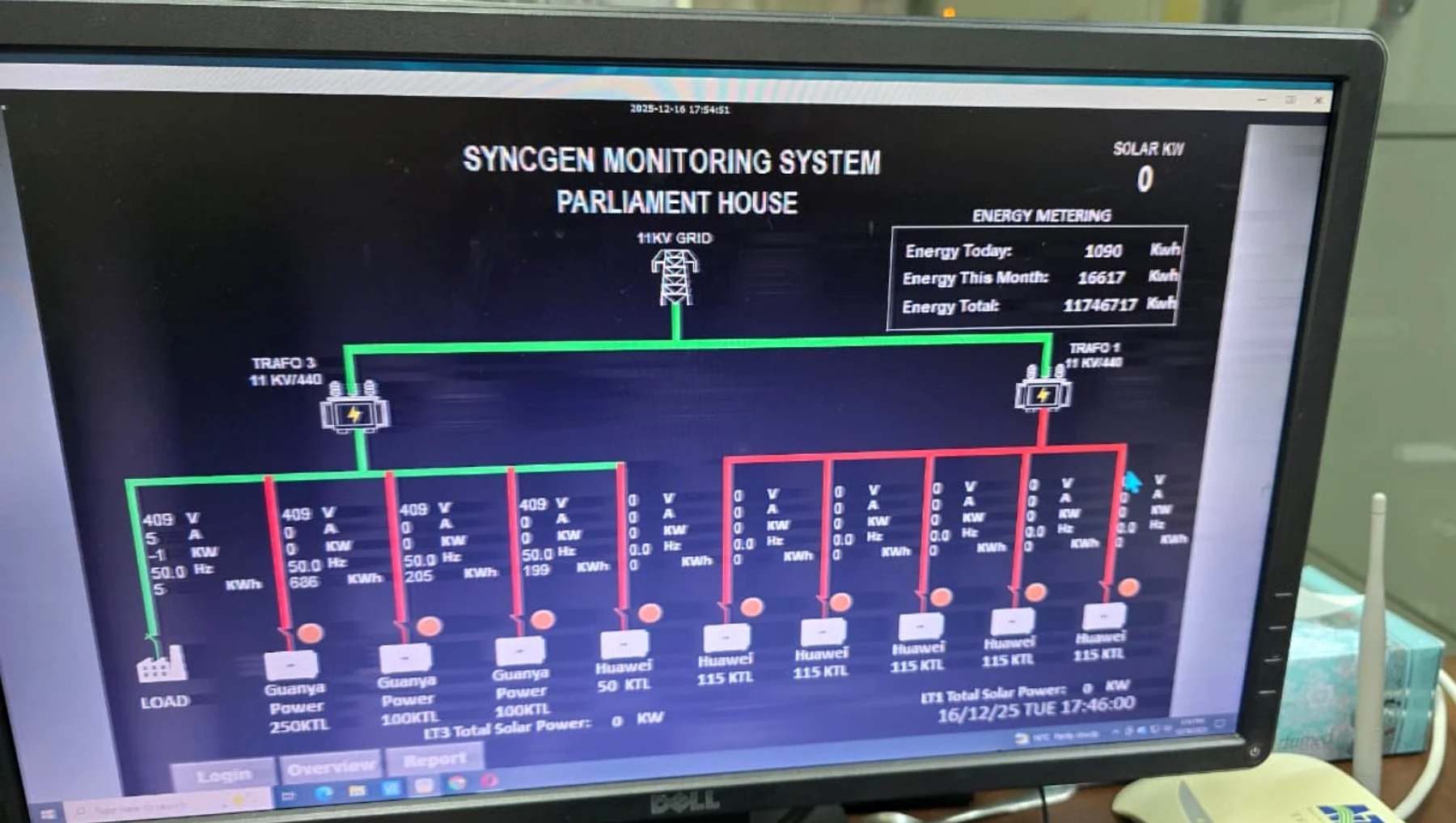
Field evidence from the installed Parliament House monitoring system.
Project Challenge
The site included newer Huawei inverters together with older Guanya Power inverters from an earlier installation. The site team needed one dependable view of generation and energy data, but the legacy inverter communication database/register map was unavailable and usable vendor support could not be established. Direct Modbus integration with those legacy units was therefore not practical.
The engineering challenge was not simply to display data from one manufacturer. It was to recover useful visibility from a mixed-vendor system where part of the installed equipment could communicate directly and part could not.
JME Integration Approach
JME used the available Huawei data interface for the newer inverter groups and created a separate acquisition path for the legacy equipment. Dedicated industrial RTU energy meters were installed to measure the electrical output of the Guanya inverter groups independently of their unavailable internal communication database. Those measurements were then integrated into the unified SyncGen monitoring and SCADA layer.
When legacy communication could not be recovered reliably, JME created an independent metering layer instead of allowing the unavailable inverter database to block the monitoring project.
System Architecture Visible on the SLD
- 11 kV grid connection represented across two transformer/LT sections for clear system segregation
- Three legacy Guanya Power inverter groups shown on the monitoring architecture: one 250 KTL and two 100 KTL units
- Six Huawei inverter groups shown: one 50 KTL and five 115 KTL units
- Huawei data brought in through the available Huawei communication path
- Legacy inverter production captured through dedicated RTU energy metering
- Unified visualization of solar generation, electrical values and energy information on one operator screen
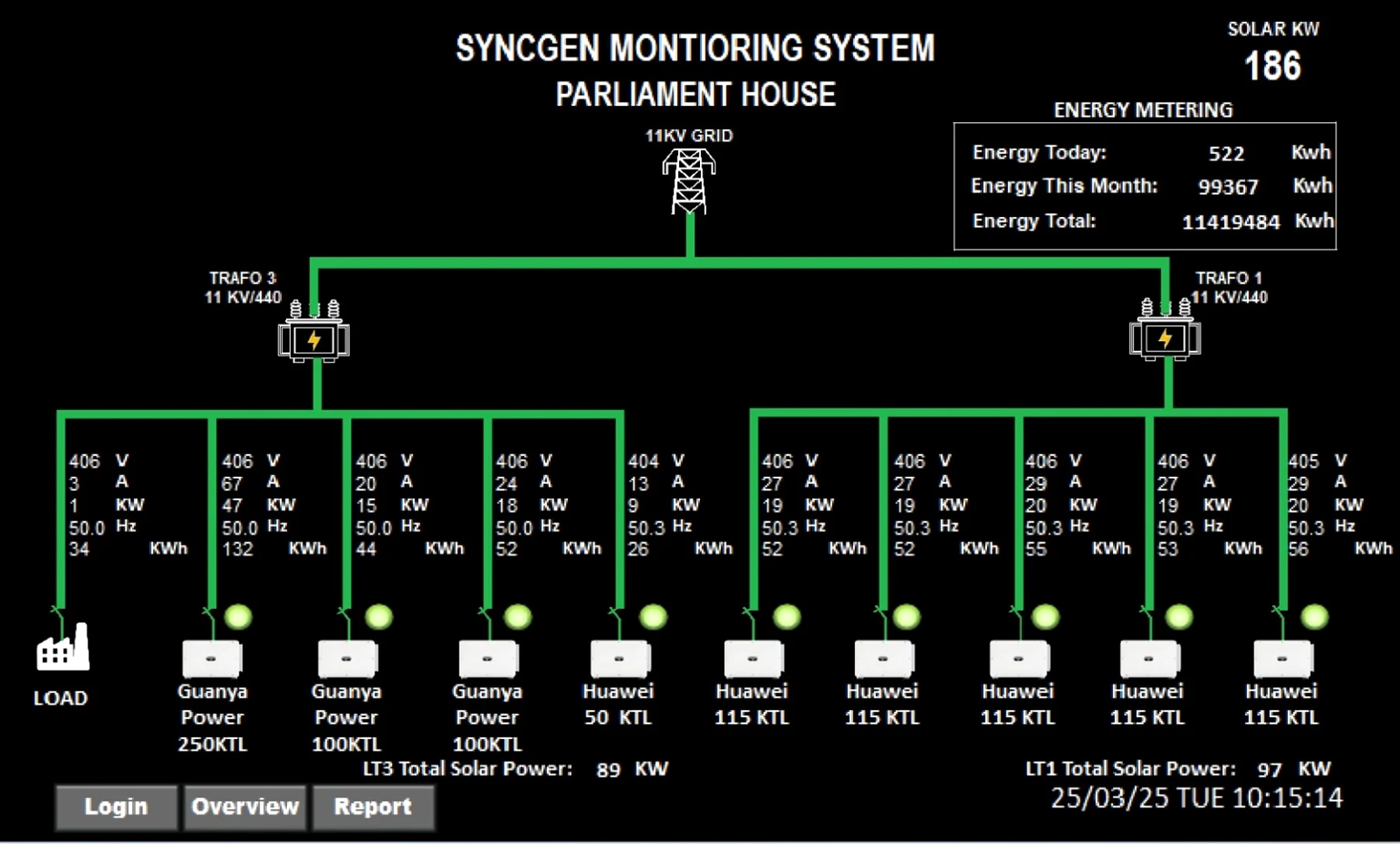
Unified Parliament House SCADA view combining newer Huawei data with legacy inverter production captured through the JME integration layer.
SCADA and Energy Monitoring
The SyncGen operator screen combines the mixed inverter fleet into one single-line-style view. It presents inverter-group status, electrical measurements, total solar power and energy figures while keeping the LT sections visually separated so the site team can understand where production is coming from without moving between separate manufacturer interfaces.
Values visible in project screenshots represent live readings at the time they were captured. They are used as evidence of the monitoring architecture, not as permanent generation or performance claims.
Management and Sustainability Dashboard
A separate executive-facing dashboard was developed for management. Instead of showing the detailed electrical single line, it presents high-level production and sustainability indicators such as daily generation, total generation, CO2 reduction and other green-performance metrics in a simple management view.
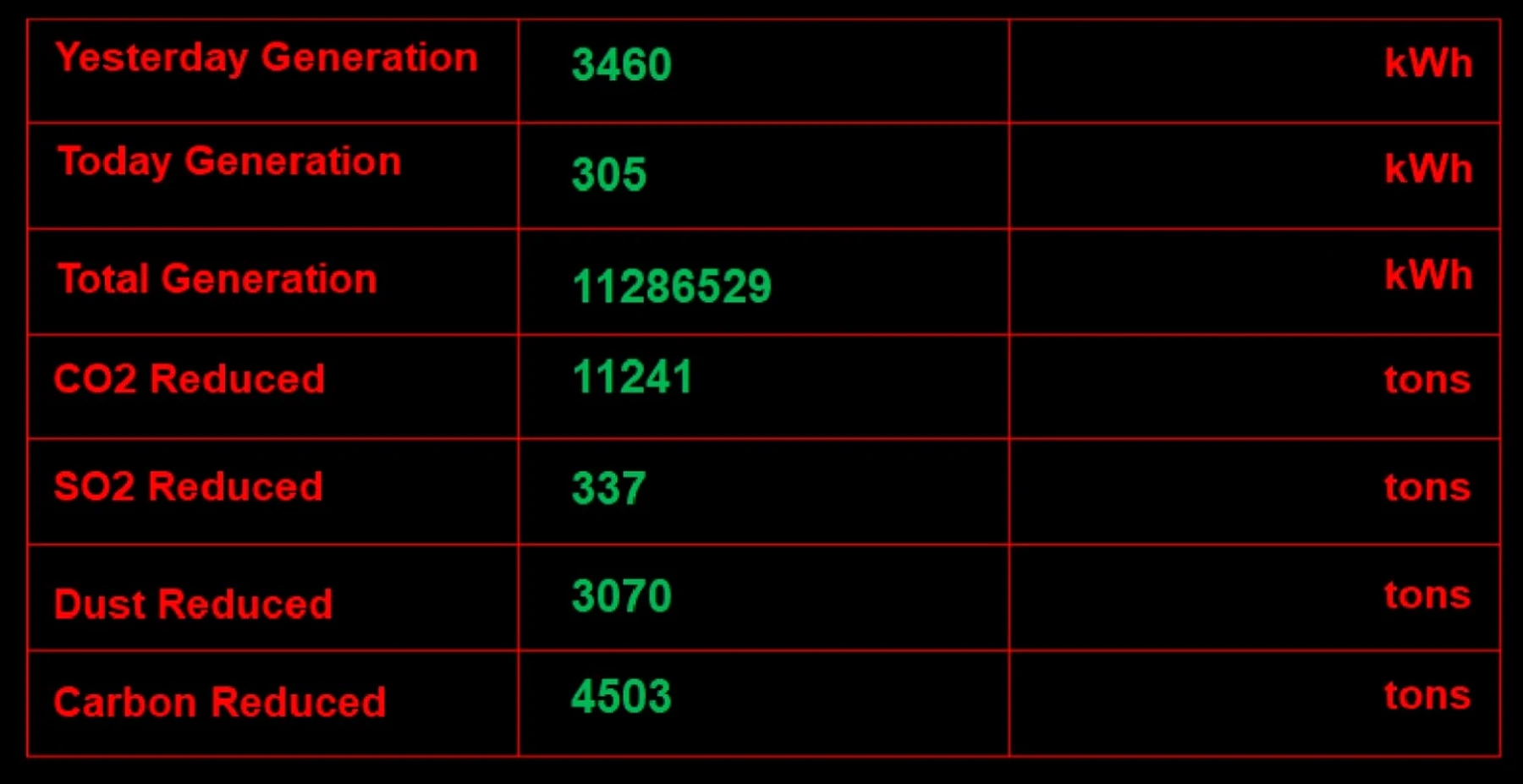
Executive energy dashboard created for a simplified management view of production and environmental indicators.
These environmental figures are shown as part of the site’s monitoring presentation layer. JME does not present them here as independently audited sustainability claims.
Online Monitoring for the Site Team
The completed monitoring architecture is online-enabled, allowing the site team to review production from the different inverter groups through one centralized interface. This reduces dependence on separate vendor tools and provides a clearer operational picture when reviewing generation or investigating data gaps.
Engineering Value
This project demonstrates JME’s strength in brownfield integration: understanding an existing system, separating what can communicate directly from what cannot, creating an alternative data-acquisition path where necessary, and then presenting the result through one maintainable monitoring architecture.
- Mixed-vendor solar integration
- Legacy-system data recovery through independent metering
- RTU energy-meter integration
- SCADA and HMI development
- LT-wise electrical visualization
- Online energy monitoring
- Executive management dashboards
- Retrofit engineering without unnecessary replacement of working equipment
Need to Integrate a Legacy Energy System?
If your plant has undocumented equipment, unavailable register maps, mixed inverter brands or disconnected monitoring systems, JME Energy & Automation can assess the installed architecture and develop a practical integration strategy around the equipment that is already working.
Related JME work: Projects & Case Studies, Punjab Assembly SCADA & Energy Monitoring, SYNCGEN EMS, and the BESS + Solar + Genset + Grid EMS case study.
No guesswork. Know before you buy. Send JME your SLD, equipment list or existing-system information and we can first identify the likely integration path, communication gaps and technical risks before you commit to a full project.
Related JME engineering capabilities include SCADA Systems, Industrial Energy Monitoring and Energy Management Systems.